

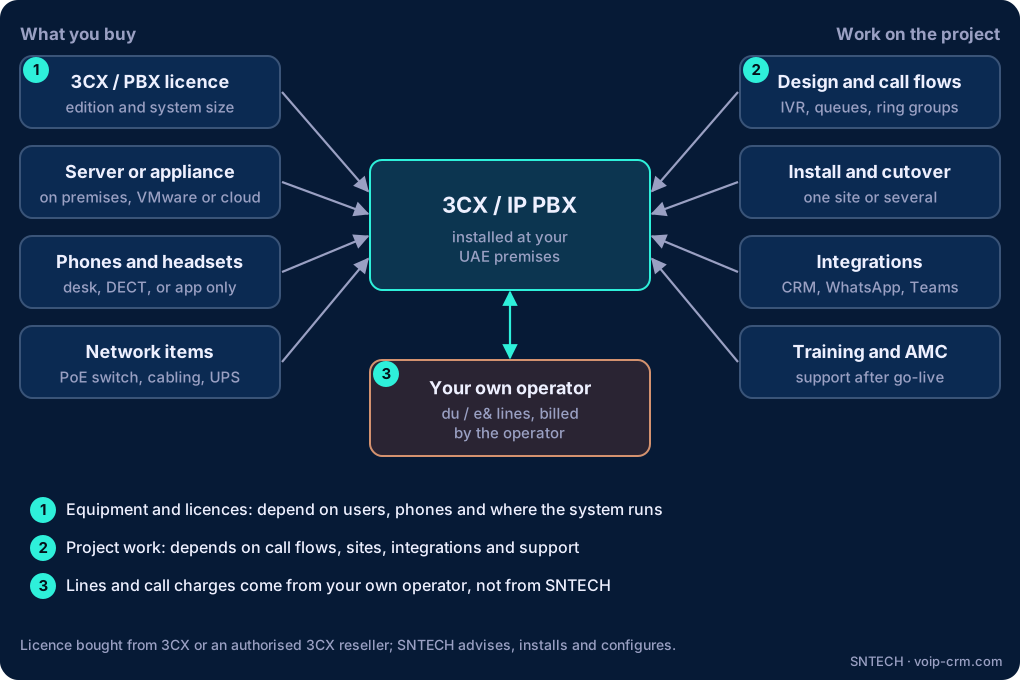
The cost of a 3CX or IP PBX project in the UAE depends mainly on six things: how many users you have, which phones they need, where the system runs, how ready your network is, how complex your call flows and integrations are, and what support you want after go-live. The licence is usually only one part of the quotation. Below, each factor in plain terms, so you can compare quotations fairly. We do not list prices, because they depend on your office and change over time.
One point first: SNTECH is a systems integrator. Your phone system is installed at your UAE premises and uses lines from your own licensed operator (du or e&). Line rental and call charges come from your operator, not from us, so they are not part of a PBX project quotation.
The main cost factors of a 3CX or IP PBX project
Every phone system quotation has two sides: what you buy (licence, server, phones, network items) and the work to design, install and support it. The table shows what usually pushes each one up or down.
| Cost factor | Pushes the cost up | Keeps the cost down |
|---|---|---|
| Users and system size | Many users, many calls at the same time | Sizing for real usage, with room to grow |
| Phones and headsets | A desk phone for everyone, colour touchscreen models | App or web client for laptop users, desk phones only where needed |
| Where the system runs | New dedicated server or appliance | Your existing VMware host or your own cloud account |
| Network readiness | New cabling, new PoE switch, firewall rework | Existing Cat6 cabling and PoE switch in good condition |
| Lines | Old analogue or ISDN lines that need a gateway | A SIP trunk from your operator, ready before cutover |
| Call flows and features | Multi-level IVR, several queues, recordings in two languages | Simple ring groups and one clear IVR menu |
| Integrations | Custom CRM work, WhatsApp, several sites | Ready-made CRM templates, one site |
| Support | Extended hours, frequent changes | A clear AMC scope matched to your needs |
1. Users, extensions and licence size
The 3CX licence is bought from 3CX or an authorised 3CX reseller, and its cost depends on the edition and the size of the system. Other IP PBX brands such as Yeastar and Grandstream are sized in their own ways. Before asking for a quotation, count:
- How many staff need an extension (including part-time and remote staff).
- How many people may be on calls at the same time at your busiest hour.
- Which features you really need now, such as call queues, recording or reports, and which can wait.
Buying a much larger edition “just in case” is a common way to overspend; most systems can be upgraded later.
2. Phones, headsets and the IP PBX hardware cost
In many offices, endpoints are the biggest hardware item. The choices are:
- Desk phones for reception, managers and shared desks.
- DECT cordless handsets for warehouses, showrooms and staff who walk around.
- The 3CX web client or mobile app with a good headset, for staff who work from a laptop or are often out of the office.
Mixing these is usually the smartest way to control cost. See our guide to choosing Yealink IP phones for 3CX for which model suits which desk.
3. Where the phone system runs
3CX can run on a server at your office, on your existing VMware host, or on a virtual machine in your own cloud account. A new dedicated server adds hardware cost but keeps everything on site. Reusing a healthy VMware host saves hardware, but it needs spare resources and a backup plan. Some other PBX brands come as a ready appliance, so the hardware is part of the PBX itself. SNTECH does not offer 3CX hosting; the system runs on your premises or in your own account.
4. Network and cabling readiness
A phone system is only as good as the network it runs on. Costs rise when the office needs new cable points, a PoE switch to power the phones, a UPS so phones stay up during short power cuts, or firewall changes. Our field notes from UAE offices:
- Firewall SIP settings. On many firewalls, including FortiGate, the SIP helper (SIP ALG) can break calls with one-way audio or dropped registrations. Checking this at the start avoids extra visits later.
- Old cabling in fit-out offices. Shared office buildings sometimes have untested cable runs. A quick test at the survey stage is cheaper than tracing faults after go-live.
- Voice VLAN. Separating phones from computer traffic is simple on a managed switch but may need a switch upgrade on an unmanaged one.
5. Lines from your operator
If your operator already provides a SIP trunk, connecting it is usually quick work. If you still have analogue or ISDN lines, the project needs a VoIP gateway with the right number of ports, which adds hardware and setup time. Your numbers stay with your account at du or e&. Ask your operator early for the SIP details or line information, because waiting for the operator is a common cause of delay.
6. Call flows, integrations and multi-site work
Setup time grows with the number of IVR menus, queues, ring groups, working-hour rules and recorded prompts. Recording prompts in both Arabic and English is common in the UAE, so plan who will write and record them. Integrations add separate work: connecting 3CX to your CRM, adding WhatsApp messaging, or linking branches in Dubai, Abu Dhabi and Sharjah. Each extra site may need its own visit, phones and network checks.
7. Training and support after go-live
Training for reception and team leaders, an after-hours cutover so business is not interrupted, and an annual maintenance contract (AMC) all appear on a complete quotation. A cheaper quotation that leaves these out often costs more later in extra visits.
How to get an accurate quotation
- List users and what each group needs: desk phone, cordless, or app only.
- Note your current operator, line type and how many numbers you have.
- Say where the system should run: new server, existing VMware, or your own cloud.
- Draw how calls should flow: who answers first, after hours, and holidays.
- List integrations: CRM, WhatsApp, other branches.
- Book a site survey so cabling, switches and firewall can be checked.
Frequently asked questions
Why do 3CX or IP PBX quotations differ so much between companies?
They often quote different things. Compare item by item: users, phones, server, network work, call flows, integrations, training and support.
Does the quotation include our phone lines and call charges?
No. The system uses lines from your own licensed operator (du or e&), who bills line rental and calls directly.
Can we reduce cost by using the 3CX app instead of desk phones?
Often, yes. Laptop and mobile users can use the 3CX app or web client with a headset, so desk phones are only bought where needed.
Can we keep our existing phones and cabling?
Sometimes. Supported IP phones and good cabling can usually be reused; old analogue or proprietary phones need a gateway or replacement.
What should we send to get an accurate quotation?
User numbers, phone types, current lines and operator, sites, where the system runs, call flows and integrations.
Need help?
SNTECH engineers survey, design, install and support 3CX and IP PBX systems for offices in Dubai, Sharjah, Ajman, Abu Dhabi, Ras Al Khaimah, Umm Al Quwain and Fujairah, and we give an itemised quotation so you can see exactly what is included. New to 3CX? You can download the free 3CX trial first; the licence is bought from 3CX or an authorised 3CX reseller. Call/WhatsApp +971 56 669 8244 or email sales@voip-crm.com for a site survey. See our 3CX phone system, IP PBX phone system and structured cabling pages.